
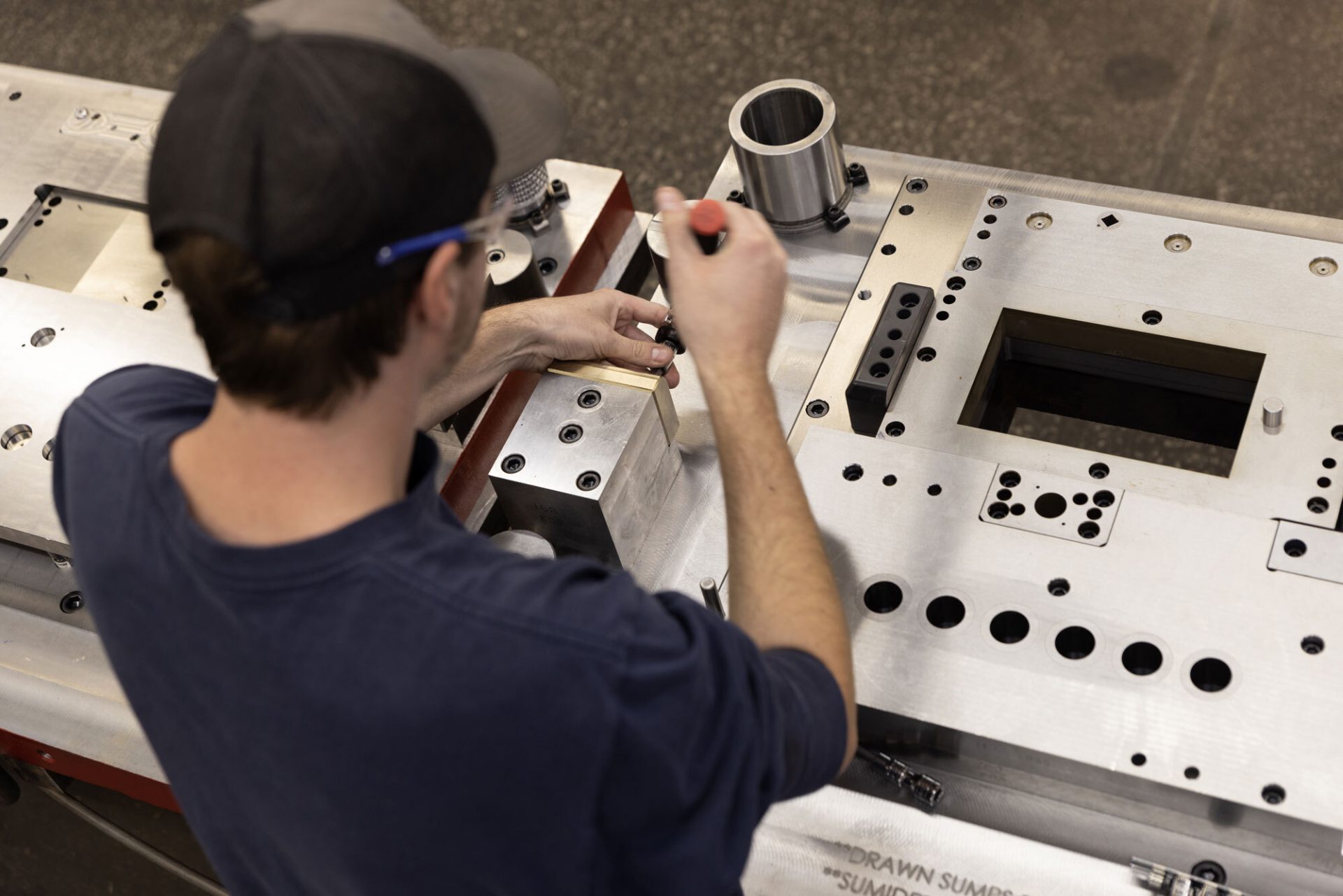
Most production challenges don’t start on the shop floor.
They start much earlier—at the tooling stage.
Decisions made during tool & die design directly influence how a part forms, how efficiently it runs, and how much it ultimately costs to produce. And while those decisions aren’t always visible during day-to-day production, their impact shows up everywhere: in cycle times, material usage, secondary operations, and long-term consistency.
Understanding that connection is key to improving performance.
Why Tooling Design Matters More Than It Gets Credit For
Tooling is often viewed as a fixed cost—something required to get a job into production.
In reality, it’s one of the most important variables in determining how that job performs over time.
Well-designed tooling can:
- Reduce or eliminate secondary operations
- Improve part consistency and reduce variation
- Minimize material waste
- Increase throughput and reduce cycle time
On the other hand, tooling that isn’t optimized can quietly introduce inefficiencies that compound over the life of a program.
The difference isn’t always obvious at launch—but it becomes clear over time.
Where Efficiency Is Won (or Lost)
Many of the biggest gains in manufacturing efficiency come from small but intentional design decisions made early in the process.
For example:
- Integrating features like tapping or forming directly into the die can remove entire downstream operations
- Consolidating multiple parts into a single tool can reduce handling, setup time, and overall tooling investment
- Designing for changeover flexibility can allow one tool to support multiple SKUs without sacrificing efficiency
These aren’t just design preferences—they’re strategic choices that shape the entire production workflow.
In practice, these kinds of decisions can have significant impact – impact like these recent improvements that Velocity clients realized:
- $450,000 reduction in tooling investment by consolidating multiple parts into a single progressive changeover die while eliminating a secondary operation
- $150,000 in annual savings by integrating an in-die tapping unit and removing a separate process step
Designing for the Full Lifecycle
Tooling doesn’t just need to work on day one. It needs to perform consistently over thousands—or millions—of cycles.
That requires thinking beyond initial function and considering:
- Tool wear and maintenance intervals
- Material behavior over extended runs
- Ease of adjustment and repair
- Process stability at scale
When those factors are built into the design from the beginning, the result is a more stable, predictable production environment.
That long-term thinking often translates into measurable cost advantages. Here are some recent client success stories, after Velocity Tool & Die improvements:
- 50% reduction in tooling cost by consolidating four dies into two without sacrificing performance
- 66% total project cost reduction through a dual-lane progressive die capable of running multiple parts from a single tool
The Role of Integration in Tooling Performance
One of the most overlooked factors in tooling success is how closely design, build, and production are connected.
- Design decisions may not fully reflect real production conditions
- Adjustments can take longer due to communication delays
- Root causes of issues can be harder to trace
By contrast, a more integrated approach allows for faster iteration, better alignment between design intent and real-world performance, and more efficient problem-solving when challenges arise.
What This Means for Manufacturers
For manufacturers, the takeaway is simple:
Improving production outcomes doesn’t always require new equipment or major process changes. Often, the biggest opportunities lie upstream—in how tooling is designed and engineered.
Better tooling design can lead to:
- More efficient production processes
- Lower total cost over time
- Greater consistency and quality
- Increased flexibility as needs evolve
A Different Approach to Tooling
At Velocity Metalworks, tool & die design is approached as a core part of the manufacturing process—not a separate step.
That means evaluating each program with a focus on long-term performance, identifying opportunities to simplify and optimize, and ensuring that tooling decisions support the broader production goals.
Because when tooling is done right, everything downstream works better.
Tooling may not be the most visible part of a manufacturing operation—but it’s one of the most influential.
And in many cases, it’s where the biggest gains are hiding.