
Where Is Your Tooling Actually Built and Maintained?
Most conversations about a stamping program begin with the part. Material, tolerance, annual volume, price. Tooling tends to enter the discussion later, usually as a line item that is quoted once and then set aside.
For programs that run at volume, that line item has more influence on the production schedule than almost anything else in the quote.
A tool is not a drawing or a document. It is a piece of equipment that runs under load, wears over time, and requires attention across the life of a program. Which leads to a practical question that procurement teams and engineers are asking more often: who builds and maintains the tooling, and how close are they to the press that runs it?
Tooling Is Equipment, Not a One-Time Purchase
The tooling quote answers one question, which is what it costs to get a program into production. It does not answer what it costs to keep that program running.
Across the life of a tool there are revisions as designs evolve, adjustments as material behavior changes, scheduled maintenance, and unscheduled repairs. Each of those events carries a timeline, and that timeline is determined largely by distance. When tooling is built and maintained far from the press that runs it, every adjustment and every repair includes transit, queue time, and coordination across time zones. When it is built and maintained in the same building, those same events are measured in hours.
Neither of those realities appears on a purchase order. Both of them appear on a production schedule.
That is why buyers should ask how a partner handles tooling revisions mid-program, what the typical turnaround is on a repair, and who performs that work. A dependable partner should be able to describe the process, not just the price.
High-Volume Programs Raise the Stakes
Industries use tooling differently, and that distinction matters when evaluating a partner.
Aerospace and defense work tends to run lower volumes with more fabrication content, where tooling requirements are real but narrow. HVAC manufacturers, appliance producers, and large consumer product OEMs operate differently. Those programs run scaled stamping with high cycle counts and long production lives. The tool is in the press consistently, which means maintenance is not a possibility to plan around but a certainty to plan for.
Velocity Metalworks supports that kind of work with press capacity ranging from 45 to 200 tons, running single hit, progressive, transfer, and draw dies. Our capabilities span stamping and punching, cutting, forming and bending, machining, welding, and coating and finishing, across two facilities in Hoffman and Belleville, Illinois.
For high-volume programs, the location and ownership of the tool room stops being a procurement detail and becomes part of the risk assessment.
What In-House Tool & Die Support Changes
The phrase “in-house tooling” is used loosely across the industry, so it is worth being specific about what it means in practice.
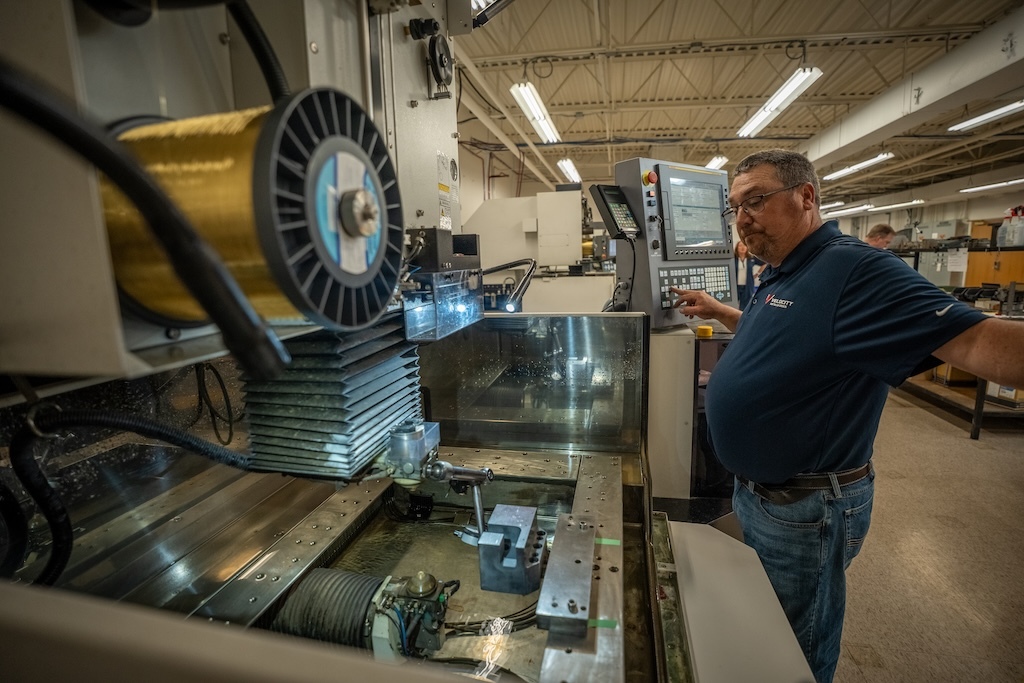
At Velocity Metalworks, tool and die work is treated as a core part of manufacturing rather than a separate step. Tooling is built and maintained by our own team, and that work happens alongside the production floor. Three things follow from that arrangement.
New tooling moves faster, because the people building the tool and the people running it are working from the same understanding of the part. Questions are resolved on the floor rather than through correspondence.
Repairs stay in the building. A tool that needs attention does not enter an outside vendor’s queue, which is the difference between a production interruption measured in hours and one measured in weeks.
And production continuity does not depend on another company’s capacity or priorities. That control is the practical benefit customers tend to notice first.
Design Decisions That Pay Off Across a Program
We covered that upstream design thinking in more depth in Smarter Tooling = Better Parts + Stronger Margins. The point worth carrying forward here is that this kind of optimization depends on proximity. Tooling designed at a distance from the floor that will run it has fewer opportunities to be improved by the people who know how the part actually behaves.
The Case for Domestic Sourcing Continues to Strengthen
For years the argument for a domestic tooling partner rested largely on risk management. That argument has broadened.
Reshoring momentum, renewed investment in domestic industrial and defense capacity, and policy that encourages regional sourcing and small business participation have made a United States based tooling partner easier to justify on its own merits rather than as a contingency. For buyers who have spent recent years absorbing freight volatility and schedule uncertainty, sourcing tooling closer to production has begun to look less like a premium and more like protection that pays for itself the first time a tool needs work.
Velocity Metalworks has been supporting manufacturers since 1970, more than fifty years of history in this industry. Our facilities and our tool room are located in Illinois, which puts us in the middle of the Midwest manufacturing base and within practical reach of customers throughout the region. We also support OEM and tier 1 manufacturers well beyond it, across the United States, and serve a range of industries from that footprint.
The tooling, the presses, and the people who support both are domestic. That is what makes the response times described above possible, whether a customer is an hour away or several states over.
Quality Discipline Behind the Tooling
Tooling only matters to the extent that it produces consistent parts, which makes the process around it as important as the tool itself.
At Velocity Metalworks, every operator works from detailed program packets and blueprint readings, and every set-up is double-checked by a technical lead before production runs. Our quality management system is certified to ISO 9001:2015, which means it is independently verified rather than self-reported.
We have also continued investing in equipment that supports consistency and lead times, including a Trumpf press brake with an automated tool changer and a Mazak 6K fiber laser with a material stacker that allows continuous running for extended periods.
Questions Worth Asking Any Tooling Partner
Whether you are evaluating Velocity or another supplier, a handful of questions surface most of what you need to know. Ask whether tooling is built and maintained in-house, and where that tool room is physically located. Ask what happens when a tool needs a repair mid-program, and who does that work. Ask how design changes are handled and how long a typical revision takes.
Then widen the lens. Ask about press and tool room capacity, and whether taking on your program would affect existing commitments. Ask which operations stay in-house and which are subcontracted. Ask what the inspection process looks like and who signs off before parts ship. And ask who you would call when something goes wrong, and whether that person would know your part.
We walked through that broader framework in How to Choose a Metal Manufacturing Partner. A partner who can answer these questions clearly is usually the partner worth quoting.
The Right Partner Protects the Schedule
Tooling is one piece of a larger picture. Velocity Metalworks brings full-service metal stamping, fabrication, tool and die, contract manufacturing, assembly, and logistics support together for tier 1 and OEM manufacturers, which means the company that builds your tool is also the company that runs your parts and stands behind them.
That removes a handoff, and with it the gap where accountability tends to get lost.
If you are launching a new program, requoting existing tooling, or reconsidering how your current tooling is supported, talk to our team about your timelines, parts, and requirements, or explore our full range of services to see how we can support production from design through delivery.